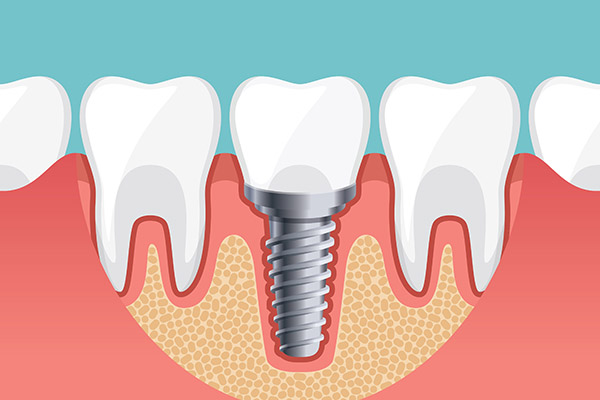
 Dental implants are an excellent option for restoring your smile's look and function while addressing the other issues associated with missing teeth. However, they require a lengthy and invasive process, which we must ensure each candidate can endure. Here are some common recommendations that help significantly increase approval odds.
The role of the gums and jawbone
Dental implants need sufficient healthy gum tissue and jawbone to be stable. The gums are soft tissues that surround the teeth and envelop the jawbone. Their primary function with dental implants is to sufficiently cover the jawbone and base of the abutment. They also act as a second secure mechanism for the abutment.
The jawbones are plates that help frame the face and support the teeth. When dental implants are added to the mix, there needs to be a sufficient hard structure to stabilize the entire implant. Further, patients will enter osseointegration after receiving the implant's post or base (comprising biocompatible materials). This process involves fusing the jawbone and post.
Treatments to improve approval odds
The general dentist often denies approval due to an infection or degeneration. One can develop many types of infection, but gum disease is the most common. The National Library of Medicine reports that 42 percent of adults over 30 years of age have a form of gum disease, while the number skyrockets to 60 percent for adults 65 and older. Degeneration refers to the gum tissue or underlying bone structure receding from its natural position—a common side effect of tooth loss.
The dentist may recommend any of the following treatments to increase approval odds:
Gum disease treatment
Gum disease treatment will depend on the severity. For those with gingivitis, the dentist may recommend scaling and root planing. This procedure removes plaque and tartar (hardened plaque) from above and below the gum line, especially focusing on the teeth' roots. They will also prescribe an antibiotic to rid the inner structures of the gums of the disease. For those with periodontitis, the dentist may recommend flap surgery to physically lift the gums and remove tartar from the entire teeth' structures before prescribing an antibiotic.
Gum grafting
Gum grafts involve harvesting healthy tissue from elsewhere in the body and placing it in areas with degeneration. While dentists can employ multiple methods, the primary area from which they harvest tissue is in the mouth. For example, the roof of the mouth and the buccal mucosa (cheek tissue) are two places the dentist will check for healthy tissue first. The harvested tissue will then fuse with the surrounding areas of its new position.
Bone grafting
Bone grafts can involve harvesting natural bone from elsewhere in the patient's body and placing it where the underlying bone is degenerating. However, the most common type of bone graft the general dentist will employ is a synthetic material that simulates the natural jawbone. Regardless of the material chosen, the graft will fuse with the natural jawbone, becoming one.
Increase your dental implant approval odds
Do not be discouraged if you have been denied candidacy for dental implants. We can recommend treatments to restore your oral health and improve approval odds. Contact us today to schedule a consultation.
Request an appointment or call Weiss Advanced Dentistry PLLC at 860-406-3181 for an appointment in our Southington office.
Related Posts
Dental implants are the teeth replacement option that most closely resembles natural teeth in form and function. One of their most attractive benefits is their incredible versatility. For those in need of single-tooth or multiple teeth replacement, dental implants provide a durable and aesthetically pleasing solution.The dental implant refers to the screw-shaped metal implant the…
Dental implants are one of the most durable and attractive ways to replace missing teeth. They are a favorite among dental professionals due to their ability to address every issue that results from missing teeth. Learning more about degeneration and dental implants can help narrow down your tooth replacement options list.When a tooth is lost,…
A partial denture or dental implant can replace a missing tooth. Research shows that most people prefer implants to dentures. Awareness of when to choose an implant over a denture can help prepare you for your treatment. Here are the details on when you must choose a dental implant over a denture.A dental implant is…